

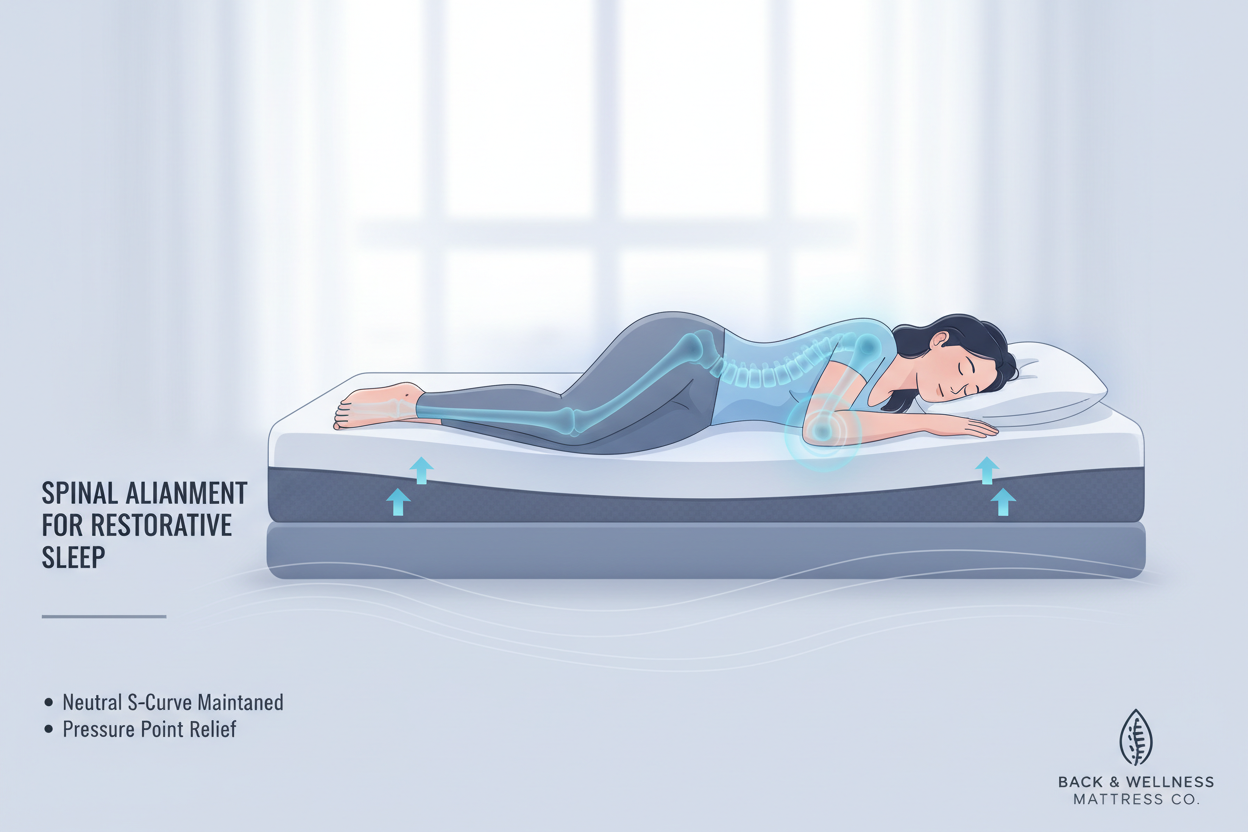
Back pain is one of the most common reasons people struggle with sleep. Whether it’s stiffness in the morning or discomfort that builds overnight, the wrong mattress can aggravate spinal misalignment and prevent proper recovery.
Choosing the right mattress for back pain is not about guesswork or trends. It’s about understanding how your spine is supported during sleep and selecting a mattress designed to maintain healthy alignment.
Why Your Mattress Matters for Back Pain
Your spine has a natural curve that must be supported evenly throughout the night. If a mattress is too soft, your hips can sink too deeply. If it’s too firm, pressure builds in the shoulders and lower back. Both scenarios force muscles to stay active while you sleep, leading to pain and stiffness.
A mattress designed for spinal support helps your muscles relax, reduces pressure on joints, and allows the body to recover properly.
Step 1: Understand Neutral Spinal Alignment
Neutral spinal alignment means your spine maintains its natural curve while lying down.
A supportive mattress should:
- Keep the spine straight when viewed from the side
- Support the lumbar region without pushing it forward
- Allow shoulders and hips to settle comfortably
This balance is critical for reducing strain on muscles and discs.
Step 2: Choose the Right Firmness Level
Firmness plays a major role in comfort, but it must work with support.
General guidance:
- Back sleepers usually benefit from medium to medium-firm support
- Side sleepers often need pressure relief with supportive zoning
- Stomach sleepers typically require firmer support to prevent lower-back compression
The goal is support without excessive sink or pressure.
Step 3: Look for Zoned Support Systems
Zoned support means different areas of the mattress provide different levels of support.
This is especially important for back pain because:
- Heavier areas (hips) receive stronger support
- Lighter areas (shoulders) are gently cushioned
- The lumbar spine remains supported throughout the night
Chiropedic’s back care mattresses are designed with this principle in mind, focusing on spinal alignment and pressure distribution.
Step 4: Consider Your Body Type and Weight
Body weight influences how much a mattress compresses.
- Lighter sleepers may feel firmer mattresses as too hard
- Heavier sleepers often need stronger core support to prevent sagging
- Average-weight sleepers typically benefit from balanced support systems
A mattress must support your body without collapsing over time.
Step 5: Prioritise Pressure Relief
Pressure points around the hips, shoulders and lower back can cause tossing and turning, interrupting deep sleep.
A mattress suitable for back pain should:
- Distribute weight evenly
- Reduce pressure at contact points
- Support joints without rigidity
Effective pressure relief helps you stay asleep longer and wake with less stiffness.
Step 6: Check Mattress Durability
Back pain often worsens on mattresses that have lost their structure.
High-quality mattresses use:
- Dense support layers
- Reinforced edges
- Materials designed to retain shape over time
Durability is essential for maintaining spinal support long-term.
Step 7: Test With a Sleep Trial
Your body needs time to adjust to improved support.
A sleep trial allows you to:
- Experience real spinal alignment
- Let muscles adapt to proper support
- Evaluate morning comfort after several weeks
Avoid judging a mattress based on the first night alone.
Where to Start
If back pain is affecting your sleep, start by exploring mattresses engineered specifically for spinal support. The Chiropedic mattress collection includes options designed to support alignment, reduce pressure and promote healthier sleep.
Final Thoughts
Back pain and poor sleep often go hand in hand — but the right mattress can make a meaningful difference. By prioritising spinal alignment, zoned support, appropriate firmness and durability, you can choose a mattress that supports your body rather than working against it.
Quality sleep begins with proper support.


